
Short answer: estimate coconut plant utilities from the mass balance, per tonne of finished product. The dryer’s evaporation load sets steam or fuel demand. Nut count sets the coconut water and wash-water effluent. The supplier’s motor list sets the electrical load. In the illustrative desiccated coconut example below, one tonne of product needs about 2.4 tonnes of steam and releases 1.8–3.5 tonnes of coconut water.
This guide is for investors, consultants and utility engineers preparing a feasibility study or site plan for a coconut processing plant. The worked example is a desiccated coconut (DC) line, the most common first project. The same method applies to virgin coconut oil (VCO), coconut milk, cream, milk powder and coconut water lines. All figures are illustrative and show the method; your supplier’s design figures replace them.
Which utilities does a coconut processing plant need?
A coconut processing plant needs five utility groups: thermal energy (steam, hot air or thermic fluid), electricity, process water, compressed air and effluent treatment. Their relative size depends on the product line.
| Product line | Main thermal loads | Main electrical loads | Main water and effluent issues |
|---|---|---|---|
| Desiccated coconut | Dryer (largest), steam blancher | Dryer fans, grinder, deshelling and paring machines, conveyors | Coconut water released at splitting, kernel washing, wet-zone cleaning |
| Virgin coconut oil | Low-temperature drying of gratings (dry route) or warm separation (wet route) | Expeller or centrifuge, grinder, filter press | Coconut water, skim and wash water on the wet route |
| Coconut milk and cream | Pasteurising, retort or UHT, plus CIP heating | Extractor, homogeniser, refrigeration | CIP water and chemicals, residue handling |
| Coconut milk powder | Spray dryer inlet air (largest), evaporator if used | Spray dryer fans, atomiser, homogeniser | CIP of wet and dry ends |
| Packed coconut water | Pasteurising or other heat treatment | Chilling, filling | Rejected water, CIP |
Our comparisons of chilled, retorted and UHT coconut milk and spray versus freeze drying for milk powder describe those thermal steps in more detail.
How much steam does a desiccated coconut plant use per tonne?
In the illustrative example below, a steam-heated DC line needs about 2.4 tonnes of steam per tonne of DC: about 2.2 t for the dryer and about 0.2 t for the blancher. The steps and assumptions:
- Evaporation. One tonne of DC at 3% moisture holds 970 kg of dry solids. At 50% moisture (wet basis) in the wet gratings, the dryer feed is 1,940 kg, so 940 kg of water must be evaporated.
- Minimum evaporation heat. 940 kg × about 2,400 kJ/kg ≈ 2,260 MJ. This is theory only.
- Dryer heat supplied. Assume 50% dryer thermal efficiency (evaporation heat ÷ heat put into the air). That gives about 4,510 MJ. This efficiency is an assumption, not GTI performance data.
- Dryer steam. Assume steam at 8 bar absolute in the air heater, giving up its latent heat of about 2,048 kJ/kg (steam tables), with condensate returned. That is about 2,200 kg of steam.
- Blancher. Heating 1,940 kg of wet meat from 30 °C to 85 °C, at an assumed specific heat of 3.0 kJ/kg·K, needs about 320 MJ. With an assumed 30% allowance for losses, that is about 416 MJ, or about 200 kg of steam.
- Boiler fuel. Each kilogram of steam at 8 bar from 60 °C feedwater needs about 2,517 kJ. That is 2,768 kJ/kg steam enthalpy minus 251 kJ/kg feedwater enthalpy. At an assumed 75% boiler efficiency, 2,400 kg of steam needs about 8,100 MJ of fuel. That is about 460 kg of coconut shell at 17.7 MJ/kg net calorific value.
The nuts behind one tonne of DC supply far more shell than that. At about 10,000 nuts per tonne (Coconut Development Board project profile) and 0.12–0.17 kg of shell per nut, they give 1.2–1.7 tonnes of shell. As our sizing guide shows, raising wet-feed moisture from 50% to 55% increases the evaporation load by about 23%, so dewatering after washing and blanching directly affects the boiler. If the dryer is heated by a shell furnace through a heat exchanger instead of by steam, the boiler is smaller. Our shell fuel heat balance covers that route.
Planning a coconut processing plant with a full utility schedule? Request a quotation from GTI.
Tell us your product, target capacity, raw-material data and site location. GTI Group engineers will review it and prepare a proposal for your project, in India or abroad.
How should electrical load be estimated?
Electrical load should be built from the supplier’s motor and heater list, not from a rule of thumb, and kept separate from thermal energy. Use three figures:
- Connected load (kW): the sum of every motor, heater and control panel rating. This sizes the transformer and incoming supply.
- Running (absorbed) load (kW): what the plant actually draws at design throughput. Motors rarely run at nameplate. Ask the supplier for absorbed power at the guaranteed duty, especially for dryer fans, which are usually the largest continuous electrical load.
- Specific electrical energy (kWh per tonne of product): running load ÷ output. This is the figure to compare between quotations, next to thermal energy per kilogram of water evaporated.
Plan for power quality and continuity too. Check the site supply voltage and frequency against the equipment design. Induction motors built for 50 Hz run about 20% faster on 60 Hz, as our guide to importing a coconut processing plant explains. Where grid supply is unreliable, consider a standby generator sized for safe shutdown or continued running of critical loads. Critical loads are dryer fans, burner and steam controls, and PLC panels. A dryer that loses its fans with hot coils or a hot furnace can scorch product or create a fire risk.
How much water and effluent should be planned?
Plan water and effluent from nut count and cleaning regime, and treat coconut water as the largest single liquid stream in most kernel plants. Sri Lankan cultivar trials measured 179–349 g of nut water per mature nut. At about 10,000 nuts per tonne of DC, that is about 1.8–3.5 tonnes of coconut water for every tonne of DC, more than the product itself. It is rich in sugars and organic matter, so discharging it untreated places a heavy load on any treatment plant. Our article on mature coconut water from a DC or VCO plant compares recovery routes such as vinegar, concentrate and powder.
The other water streams to estimate are:
- Kernel washing after paring: set by the washer design and recirculation.
- Boiler feedwater: steam generated plus blowdown, minus condensate returned. Steam injected directly into a blancher is not returned, so it is all make-up.
- Cleaning: wet-zone hose-down and CIP for liquid lines. The dry zone of a DC plant should be dry-cleaned, which also reduces effluent.
- Cooling and utilities: compressor and refrigeration cooling, where water-cooled.
- Domestic: staff facilities, kept separate from process drainage.
Discharge limits are set nationally and sometimes by state or province. In India, for example, the general standards under the Environment (Protection) Rules, 1986 limit BOD to 30 mg/L for discharge into inland surface water. Check the limits that apply at your site before sizing treatment, and segregate high-strength streams such as coconut water from dilute wash water.
What should a utility schedule for a coconut plant contain?
A utility schedule should list each consumer with its design and peak demand, in the same units, so the site team can size boilers, transformers, tanks and treatment. Use this template:
| Utility | Figures to request or calculate | Basis |
|---|---|---|
| Steam or thermal fluid | kg/h at stated pressure, per consumer; peak at start-up | Evaporation load and dryer efficiency; blancher and CIP duty |
| Fuel | kg/h of shell, oil or gas; storage days | Boiler or furnace efficiency, net calorific value |
| Electricity | Connected kW, running kW, kWh per tonne; voltage and frequency | Supplier load list at guaranteed duty |
| Process water | m³/day by use; quality (hardness, microbiology) | Washer design, boiler make-up, CIP cycles |
| Compressed air | Nm³/h at pressure; dried and filtered where it touches product | Pneumatic valves, packing machines, conveying |
| Effluent | m³/day and load by stream (coconut water, wash, CIP) | Nut count and cleaning regime; local discharge limits |
Include this schedule, or the data needed to build it, when you request quotations. Our quotation checklist shows how to ask for thermal and electrical energy as separate guaranteed figures. Our dryer acceptance test guide shows how to verify them at handover.
Does GTI plan utilities for coconut plants?
Yes. Genex Tech Industries LLP (GTI Group) lists plant layout and utility planning within its turnkey coconut project scope, along with process design, installation and commissioning. Utility figures for a specific project are prepared from the agreed product, capacity, raw-material data and site conditions. For dryer energy questions beyond coconut, GTI’s guide to dryer energy audits and specific energy consumption on gtidryers.com explains the measurement side.
Frequently asked questions
The dryer. Evaporating about 0.94 kg of water per kg of DC sets most of the steam or fuel demand, and dryer fans are usually the largest continuous electrical load.
In most DC plants, yes on quantity. In the illustrative example, a steam-heated line needs about 460 kg of shell per tonne of DC, while the nuts supply 1.2–1.7 tonnes. Fuel handling, storage and backup still need planning.
They are different utilities with different costs and suppliers. Combining them hides where savings are possible and makes quotations hard to compare.
About 1.8–3.5 tonnes per tonne of DC, based on measured nut-water weights of 179–349 g per nut and about 10,000 nuts per tonne. Actual figures depend on your nuts.
No. They are illustrative calculations with stated assumptions. A project utility schedule is prepared from your product, capacity, raw-material data and site conditions.
Related guides and GTI equipment
This guide is part of GTI’s coconut processing series. Related reading and equipment:
- DC plant sizing mass balance: evaporation load.
- shell fuel heat balance: furnace-fired route.
- mature coconut water options: largest effluent stream.
- importing a coconut processing plant: power supply and site readiness.
- GTI turnkey coconut projects: scope incl. utility planning.
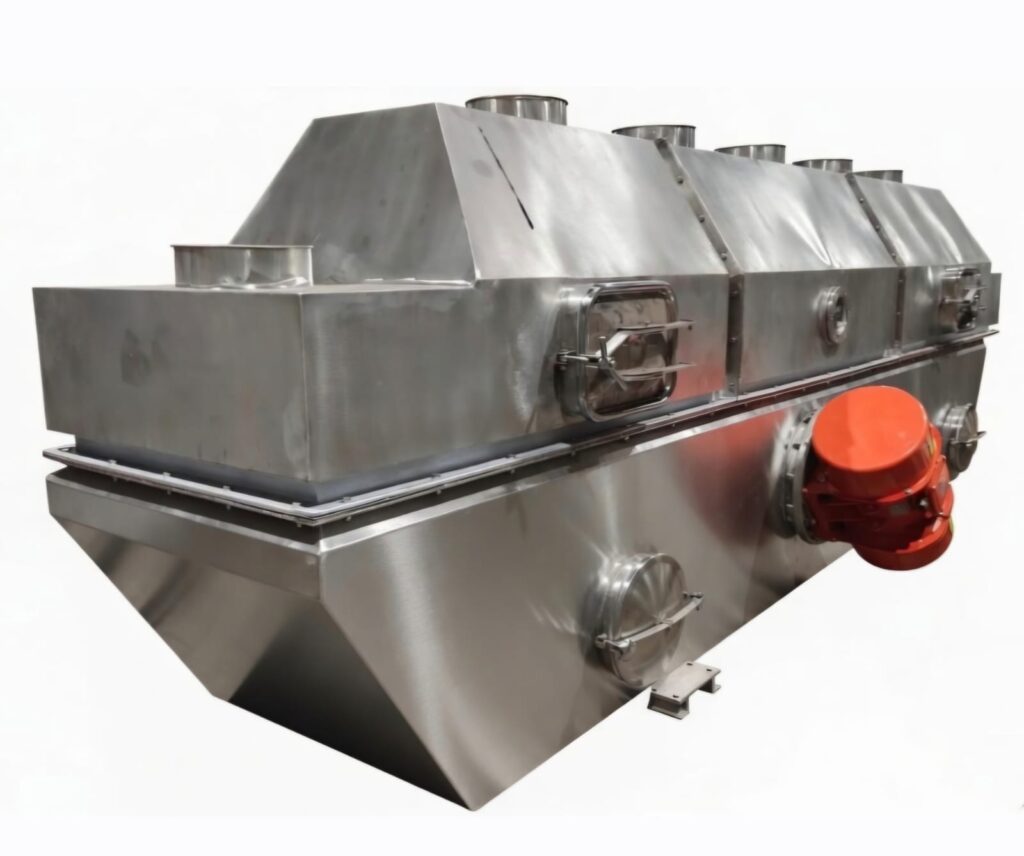
- GTI vibratory fluid bed dryer: dryer page.
- dryer heat-source selection on gtidryers.com: steam, thermic fluid or biomass.
Sources
- NIST Chemistry WebBook, Thermophysical Properties of Fluid Systems (saturated steam at 8 bar: latent heat about 2,048 kJ/kg; vapour enthalpy about 2,768 kJ/kg).
- Coconut Development Board, Desiccated Coconut project profile (yield of 1 tonne from 10,000 coconuts).
- Bureau of Energy Efficiency (India), Fuels and Combustion (coconut shell analysis used for the 17.7 MJ/kg net calorific value).
- A Comparative Assessment of Fruit Components of Recommended Coconut (Cocos nucifera L.) Cultivars in Sri Lanka, Coconut Research Institute of Sri Lanka / Rajarata University of Sri Lanka repository (nut water 179–349 g per nut).
- Environment (Protection) Rules, 1986, Schedule VI, General Standards for Discharge of Environmental Pollutants, as published by the Tripura State Pollution Control Board.
About this article
Prepared by the Genex Tech Industries LLP (GTI Group) editorial team as a feasibility method. Efficiencies, specific heats and loss allowances are stated assumptions, not measured GTI data. Project utility figures must come from the supplier’s design for the agreed duty and be reviewed by the project engineer.
Request a quotation for a coconut processing plant with a full utility schedule
Send your capacity, product specification and site details through our quotation request form, and GTI Group will respond with a proposal.
For more information, email mktg@coconutprojects.com or call or WhatsApp us on +91-87774 75596.