
Short answer: coconut milk is a low-acid food. Codex sets a minimum pH of 5.9, far above the 4.6 boundary used for low-acid foods. Any coconut milk sold at ambient temperature must therefore be commercially sterile, either sterilised in the sealed can or pouch (retort) or sterilised by ultra-high temperature (UHT) treatment and then filled aseptically. Pasteurised coconut milk is a valid product, but only with a cold chain. Choose the route by market first: where and how the product will be stored and sold, the pack format and the shelf life buyers expect. Then design the emulsion stabilisation and the line around that choice.
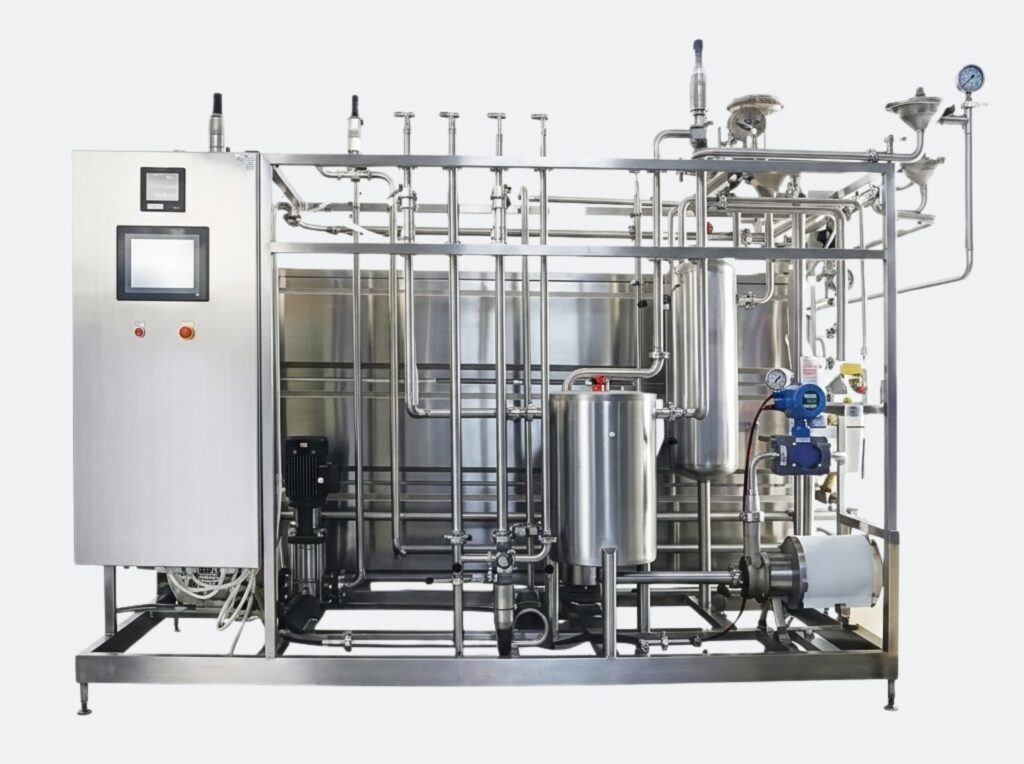
This guide is for entrepreneurs, food technologists and project consultants comparing coconut milk preservation routes before buying equipment.
What the Codex standard requires
The Codex standard for aqueous coconut products (CXS 240-2003) covers light coconut milk, coconut milk, coconut cream and coconut cream concentrate. It requires the product to be “processed by heat, in an appropriate manner, before or after being hermetically sealed in a container, so as to prevent spoilage”. It does not prescribe a time and temperature. That must come from a validated thermal process.
| Product | Total solids (% m/m) | Non-fat solids, min | Fat, min | pH, min |
|---|---|---|---|---|
| Light coconut milk | 6.6–12.6 | 1.6 | 5.0 | 5.9 |
| Coconut milk | 12.7–25.3 | 2.7 | 10.0 | 5.9 |
| Coconut cream | 25.4–37.3 | 5.4 | 20.0 | 5.9 |
| Coconut cream concentrate | 37.4 min | 8.4 | 29.0 | 5.9 |
Source: Codex CXS 240-2003, section 3.1.3.
The standard also lists permitted emulsifiers and stabilisers. These include polysorbates, mono- and diglycerides, sucrose esters, guar, xanthan and gellan gums, and sodium carboxymethyl cellulose. Sodium benzoate is permitted only for pasteurised coconut milk. It refers producers to the Codex hygiene codes for aseptically processed low-acid foods (CAC/RCP 40-1993) and for low-acid canned foods (CAC/RCP 23-1979).
The three routes compared
| Pasteurised, chilled (or frozen) | Retort-sterilised in container | UHT with aseptic filling | |
|---|---|---|---|
| Microbial target | Reduce vegetative microbes; cold chain controls the rest | Commercial sterility in the sealed pack | Commercial sterility of product, then sterile filling into sterile packs |
| Storage | Refrigerated or frozen | Ambient | Ambient |
| Typical packs | Bottles, pouches, bulk containers | Cans, retortable pouches, some bottles | Cartons, aseptic bags, bulk aseptic containers |
| Heat load on product | Lowest | Highest: the pack’s slowest-heating point must reach the target lethality | High temperature for seconds; less total heat damage than in-pack sterilisation |
| Main quality risks | Short shelf life; souring if the cold chain breaks | Cooked flavour, darker colour, protein curdling, oil separation | Emulsion breakdown, fouling of heat exchangers, aseptic integrity failures |
| Capital and skills | Lowest | Moderate; process validation per pack size | Highest; aseptic validation and sterile-zone discipline |
| Best fit | Local foodservice, food manufacturers with cold storage, bulk ingredient supply | Retail export, varied pack sizes, moderate volumes | High-volume beverage or culinary cartons, industrial bulk ingredient supply |
Planning a coconut milk or cream line? Request a quotation from GTI.
Tell us your product, target capacity, raw-material data and site location. GTI Group engineers will review it and prepare a proposal for your project, in India or abroad.
Why sterilisation is hard on coconut milk
Coconut milk is an oil-in-water emulsion. In milk pressed without added water, roughly a third is oil. The emulsion is held together partly by coconut proteins at the droplet surface. Intense heat denatures those proteins. Without help, the emulsion can curdle, separate into an oil layer and a watery layer, or form lumps. A review in the ICC journal noted that the heat treatment needed for low-acid coconut milk makes the protein denature and the product solidify “unless preventive measures are taken”, such as protein removal or stabilisers (Hagenmaier, CORD). Common quality complaints about canned coconut milk include a tinny flavour, lumps and a grey colour.
Practical countermeasures:
- Standardise first: adjust fat and total solids to the target style before heat treatment (see the example below).
- Homogenise before heat: smaller, more uniform droplets resist creaming and coalescence. GTI’s coconut milk line includes a homogeniser for this reason.
- Use permitted stabilisers and emulsifiers at validated levels. In one published UHT study, skim coconut milk was stabilised with 0.6% sodium carboxymethyl cellulose and 0.6% of a polysorbate emulsifier, homogenised in two stages and UHT-treated at 140 °C for 4 seconds (SHS Web of Conferences, 2016). The result was a stable product with residual fat below 1%. Full-fat milk and cream behave differently and need their own trials.
- Control raw material: fresh kernel, short holding times and chilled milk before heat treatment reduce the microbial load the process has to destroy.
Regulatory points for exporters
Low-acid shelf-stable foods are tightly regulated in many markets. In the United States, for example, thermally processed low-acid foods in hermetically sealed containers fall under 21 CFR Part 113, with registration and process filing requirements in 21 CFR Part 108. Thermal processes for these products are normally set by a qualified process authority, using heat-penetration studies for each pack size and product. Equipment selection should not be finalised until you know which markets you will sell into and what documentation they require.
Worked example: standardising to a target fat content
Illustrative example. The figures are assumptions chosen to show the method, not typical or guaranteed values.
Assumptions: an undiluted first-press extract at 32% fat and 40% total solids, so 8% non-fat solids. The target is 1,000 kg of coconut milk at 17% fat. Dilution is with potable water.
- Extract needed: 1,000 × 17 ÷ 32 ≈ 531 kg.
- Water added: 1,000 − 531 ≈ 469 kg.
- Resulting total solids: 531 × 0.40 ÷ 1,000 ≈ 21.3%, inside the Codex coconut milk range of 12.7–25.3%.
- Resulting non-fat solids: 531 × 0.08 ÷ 1,000 ≈ 4.2%, above the Codex minimum of 2.7%.
Run this check for every style you plan to sell. Each must meet its own Codex band or the importing country’s rules. Composition also affects heat transfer and emulsion stability, so a validated thermal process for one style does not automatically cover another.
How GTI’s coconut milk line fits these routes
GTI’s published coconut milk processing plant comprises:
- Breaking, paring and washing.
- A coconut milk extractor (published at up to 1.5 t/h, with an extraction rate stated as above 50%).
- Filtration and vibrating screens.
- A coconut milk chiller.
- A continuous pasteuriser and a homogeniser.
- Filling and packaging.
- Can sealing with a retort system.
That covers the pasteurised-chilled route and the retort route directly. UHT with aseptic filling is not listed on that page. If your market needs aseptic cartons or bulk aseptic packs, confirm the scope and any third-party aseptic equipment at the enquiry stage.
A fourth option is to avoid liquid shelf-stability altogether by drying. Coconut milk powder needs no cold chain and no in-pack sterilisation, but it needs a spray dryer, a carrier and moisture-barrier packaging. See GTI’s coconut milk powder processing plant, our comparison of spray drying versus freeze drying for coconut milk powder, and our sister site’s notes on coconut milk powder drying. For cream products, see coconut cream powder drying systems.
Decision checklist
- Where will the product be stored and sold: chilled, frozen or ambient?
- What pack formats do your buyers want: cans, pouches, cartons or bulk?
- Which styles (light milk, milk, cream) and which compositions?
- Which export markets, and what process documentation do they require?
- Has a process authority been engaged to set and validate thermal processes?
- Which stabilisers and emulsifiers are acceptable for your labels, such as “no additives” claims?
- What utilities are available? Steam and cooling water dominate the thermal side. Homogeniser, pumps and chiller compressors are the main electrical loads. Ask for both to be stated separately.
- What happens to the residue left after pressing? It can become a product: see our guide to coconut flour from coconut milk residue.
Frequently asked questions
Can I sell pasteurised coconut milk at room temperature?
No. Pasteurisation does not achieve commercial sterility, and coconut milk’s pH is too high for acidity alone to make it safe. Pasteurised coconut milk must be kept chilled or frozen through distribution.
Does adding sugar change the process?
Sweetening lowers water activity, and the ICC review notes that somewhat less heat treatment may then be needed. Most culinary coconut milk is unsweetened, though, and any change to the process must be validated.
Why does my canned coconut milk separate?
Some separation into a cream layer is normal in unstabilised products. Hard lumps, curdling or a free oil layer usually point to protein denaturation, insufficient homogenisation or a stabiliser system unsuited to the heat treatment.
Related guides and GTI equipment
This guide is part of GTI’s coconut processing series. Related reading and equipment:
- coconut milk extraction yield and fat balance: what goes into the heat-treatment step.
- CIP cleaning for coconut milk and cream lines: cleaning after UHT or pasteurisation.
- spray drying vs freeze drying coconut milk powder: if powder suits the market better.
- GTI coconut milk machinery: coconut milk line equipment.
- coconut cream powder drying systems: GTI powder option.
Sources
- Codex Alimentarius, Standard for aqueous coconut products: coconut milk and coconut cream (CXS 240-2003).
- Hagenmaier, R., Fresh and preserved coconut milk, CORD (International Coconut Community).
- UHT skim coconut milk production and its quality, SHS Web of Conferences 23, 03002 (2016), doi:10.1051/shsconf/20162303002.
- US eCFR, 21 CFR Part 113, thermally processed low-acid foods packaged in hermetically sealed containers.
About this article
This article was prepared by the Genex Tech Industries LLP (GTI Group) editorial team from the published sources listed above. The worked example is illustrative. It is general technical guidance, not a thermal process recommendation. Scheduled thermal processes must be established by a qualified process authority.
Plan your coconut milk line with GTI
Genex Tech Industries LLP (GTI Group), engineering since 1985, supplies coconut milk extraction, filtration, chilling, pasteurising, homogenising, filling and retort equipment, plus coconut milk powder plants. Tell us your markets and pack formats, and we can help you map the right route.
Request a quotation for a coconut milk or cream line
Send your capacity, product specification and site details through our quotation request form, and GTI Group will respond with a proposal.
For more information, email mktg@coconutprojects.com or call or WhatsApp us on +91-87774 75596.