
Short answer: the Philippines, which requires coconut methyl ester (CME) in all diesel sold nationwide, is still at a 3% blend (B3) in November 2026. The step-up to B4 (October 2025) and B5 (October 2026) was suspended in July 2025 because coconut oil had become expensive. Officials have since said they want B5 in 2027, but only if prices allow. For anyone planning a coconut biodiesel line, this means the mandate is a demand driver that can move either way. Size the plant on feedstock you can secure at a workable price, design for variable oil quality, and treat any blend increase as upside rather than the base case.
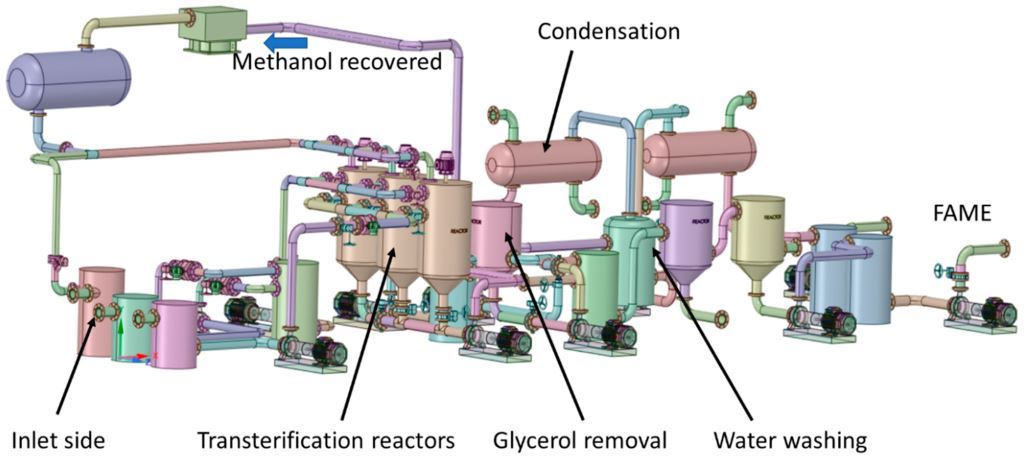
This briefing for project developers, oil millers and consultants sets out the dated policy facts, checks what one extra point of blend means in coconuts, and works through a CME plant mass balance.
Where the Philippine CME mandate stands (dated facts)
| Date | Development | Source |
|---|---|---|
| 2007 to 2009 | The Biofuels Act of 2006 (Republic Act 9367) is signed in 2007 with a 1% biodiesel blend; oil firms must offer a 2% blend from February 2009 | PCAF, 13 Mar 2026; BusinessWorld, 15 Oct 2026 |
| 1 Oct 2024 | CME blend raised from 2% to 3%, with 4% scheduled for 1 Oct 2025 and 5% for 1 Oct 2026 | Department of Energy (DOE) press release, 30 Sep 2024 |
| 29 May and 17 Jul 2025 | National Biofuels Board Resolution 2025-01 and DOE Advisory 2025-07-001 suspend B4 and B5, citing expected pump-price increases | USDA FAS GAIN report RP2025-0034 |
| 11 Mar 2026 | The National Sectoral Committee on Coconut passes a manifesto calling for an immediate move to B5 | PCAF, 13 Mar 2026 |
| Mar 2026 | A proposed amendment to allow temporary suspension of blending when blended fuel costs more than 5% above pure fuel is certified as urgent | GMA News, 31 Aug 2026 |
| 31 Aug 2026 | The Philippine Coconut Authority (PCA) says it is pushing for 5% in 2027, depending on CME price, and that local producers can supply up to a 7% blend | GMA News, 31 Aug 2026 |
| 15 Oct 2026 | DOE confirms the higher CME blend remains suspended because of the high cost of coconut oil | BusinessWorld, 15 Oct 2026 |
The price background has not eased much. A coconut-trade market newsletter dated 16 November 2026 reported crude coconut oil at about US$2,110 per tonne CIF Europe and Philippine copra prices rising again. Our analysis of coconut raw-material cost signals for 2027 covers the wider effect on food processors.
What one percentage point of blend means in coconuts
When it announced B3, the DOE estimated that each 1% increase in the CME blend needs about 100 to 120 million litres of CME a year, or about 900 million additional coconuts. That figure can be checked against published nut data.
- CME density is 0.860 to 0.900 kg/L under the Philippine CME specification. Take 0.875 kg/L: 100 to 120 million litres is about 87,500 to 105,000 tonnes of CME.
- Transesterification gives roughly one tonne of methyl ester per tonne of oil (see the mass balance below). So the oil needed is about 87,000 to 104,000 tonnes.
- Divided by 900 million nuts, that is about 0.10 to 0.12 kg of oil per nut.
A widely cited breakdown of an average 1.2 kg mature coconut (Cloin, 2005, reproduced by Raghavan, 2010) gives 0.12 kg of copra oil per nut. The DOE estimate is therefore consistent with published nut data, and sits at the upper end of plausible oil recovery. It also shows why a blend increase competes directly with food uses of coconut: every extra point needs nearly a billion nuts a year.
Planning a coconut biodiesel plant? Request a quotation from GTI.
Tell us your product, target capacity, raw-material data and site location. GTI Group engineers will review it and prepare a proposal for your project, in India or abroad.
The basic chemistry and mass balance of a CME plant
CME is made by transesterification. Coconut oil triglycerides react with methanol in the presence of an alkaline catalyst (sodium or potassium hydroxide) to give fatty acid methyl esters and glycerol. GTI’s coconut biodiesel processing plant page describes reaction at 50 to 60 °C with a 6:1 molar ratio of methanol to oil.
Worked example (illustrative): 1,000 kg of coconut oil
Assumptions: refined coconut oil with a saponification value of 255 mg KOH/g, the middle of the 248 to 265 range in Codex CXS 210-1999; complete conversion; no free fatty acids. These are theoretical figures, not plant yields.
- Average molar mass of the oil: 3 × 56,106 ÷ 255 ≈ 660 g/mol.
- Stoichiometric methanol (3 mol per mol of oil): 3 × 32.04 ÷ 660 ≈ 14.6%, or about 146 kg.
- Methanol charged at 6:1: twice the stoichiometric amount, about 291 kg. Roughly 146 kg is excess that must be recovered and reused.
- Glycerol formed (1 mol per mol of oil): 92.09 ÷ 660 ≈ 14.0%, or about 140 kg on a pure basis.
- Methyl ester: 1,000 + 146 − 140 ≈ 1,006 kg.
Across the full Codex saponification range, the stoichiometric methanol is 14.2% to 15.1% of the oil mass and glycerol 13.6% to 14.5%. Coconut oil, rich in medium-chain fatty acids, needs slightly more methanol per tonne than long-chain oils.
Scaling the example to a plant
Take an illustrative line producing 10,000 litres of CME per day, within the 500 to 100,000+ litres-per-day range on GTI’s biodiesel page:
| Item | Approximate daily quantity | Basis |
|---|---|---|
| CME output | 8,750 kg | 10,000 L × 0.875 kg/L |
| Coconut oil feed (theoretical) | 8,700 kg | CME ÷ 1.006 |
| Coconuts equivalent | about 72,500 nuts | 0.12 kg oil per nut |
| Methanol charged / consumed | 2,530 kg / 1,270 kg | 29.1% / 14.6% of oil |
| Crude glycerol (pure basis) | 1,220 kg | 14.0% of oil |
Real yields are lower than theoretical because of soap formation, washing losses and incomplete conversion. Ask any supplier for a guaranteed conversion and yield at a stated feedstock specification.
The specification your CME must meet
CME for blending in the Philippines is governed by PNS/DOE QS 002. The 2015 edition, as presented to an APEC biodiesel workshop in 2017, includes these limits (confirm the current edition before design):
| Property | Limit | Why it matters to plant design |
|---|---|---|
| FAME content | min 96.5% mass | Sets reaction completeness and separation performance |
| Methyl laurate (C12) | min 45% mass | Identifies the ester as coconut-derived |
| Acid number | max 0.50 mg KOH/g | Feedstock FFA and washing control |
| Water | max 0.05% volume | Sizes the final drying step |
| Methanol | max 0.20% m/m | Methanol stripping and recovery |
| Free / total glycerin | max 0.02% / 0.24% mass | Settling, centrifuging and washing |
| Oxidation stability at 110 °C | min 10 hours | Feedstock quality and storage |
| Cloud point | max 5 °C | Blending and cold-weather handling |
Where coconut-specific problems appear
Free fatty acids in the feedstock
With an alkaline catalyst, free fatty acids form soap. Soap consumes catalyst, makes glycerol separation harder and increases washing losses. Refined (RBD) coconut oil avoids most of this. Crude oil from poor copra, or used cooking oil, usually needs pre-treatment, commonly an acid-catalysed esterification step, before the main reaction. Copra quality therefore reaches all the way to biodiesel yield. Our guide to copra drying, moisture and aflatoxin control explains why poorly dried copra produces high-FFA oil.
Water and final drying
Washing removes soap, catalyst and glycerol traces but leaves water in the ester. The 0.05% water limit means a final drying stage is essential; GTI’s biodiesel line lists a vacuum or flash drying unit for this. Illustratively, if washed ester carried 0.5% water, a 10,000 L/day line would need to remove about 40 kg of water per day. The duty is small, so the dryer is sized mainly by residence time and temperature control, not by evaporation load. Confirm the actual water content after washing during engineering.
Energy: keep thermal and electrical separate
Thermal energy goes to heating oil to reaction temperature, methanol recovery by distillation and ester drying. Electrical energy drives agitators, pumps, centrifuges and vacuum systems. GTI’s page lists electric, steam or thermic fluid heating. Ask for both loads separately at your design capacity.
What the mandate uncertainty means for planning
- Do not build the business case on B5 alone. The 2025 suspension shows that blend increases can be delayed when coconut oil is expensive. Model B3 as the base case and higher blends as scenarios.
- Design for feedstock flexibility. A plant that can take refined oil, crude oil after pre-treatment, or used coconut oil is less exposed to price swings in one grade.
- Value the glycerol. About 140 kg of glycerol per tonne of oil is a significant by-product stream; decide early whether it will be sold crude or refined.
Buyer checklist for a coconut biodiesel line
- Design feedstock: refined, crude or used oil, with FFA and moisture limits.
- Guaranteed conversion and ester yield at that feedstock, against the current PNS/DOE QS 002 edition.
- Methanol ratio, recovery rate and the distillation system.
- Glycerol separation method (settling or centrifuge) and glycerol quality.
- Final drying method and guaranteed water content.
- Thermal and electrical loads stated separately.
- Methanol safety: storage, vapour control and hazardous-area classification.
Related equipment
Upstream, oil is pressed from dried copra with industrial oil expellers and clarified with a filter press. For copra and oil-residue drying options, see our sister site’s coconut oil and copra drying systems. A longer technical overview of the process is on the turnkey coconut biodiesel plant guide.
Frequently asked questions
Is the Philippine B5 mandate in force in November 2026?
No. As of DOE statements reported on 15 October 2026, the blend remains at 3%, with the B4 and B5 steps suspended. Check for any new DOE advisory before relying on this.
Can a CME plant use crude coconut oil?
Yes, if the free fatty acids are reduced first. The pre-treatment design depends on the FFA level, which should be measured on the actual feedstock.
Related guides and GTI equipment
This guide is part of GTI’s coconut processing series. Related reading and equipment:
- MCT oil from coconut oil: another coconut-oil derivative line.
- copra drying quality before the expeller: feedstock quality for CME.
- coconut raw-material cost signals: oil price exposure.
- GTI coconut biodiesel processing plant: turnkey CME plant.
- coconut biodiesel plant on foodtechprojects.com: group overview.
Sources
- USDA Foreign Agricultural Service, Philippines Suspends Implementation of B4 and B5 Mandates (GAIN RP2025-0034, 18 August 2025).
- Department of Energy (Philippines), press release “Implementation of 3% CME in Diesel Fuel Effective 01 October 2024”, 30 September 2024.
- Philippine Council for Agriculture and Fisheries, NSC on Coconut pushes for biofuel expansion, 13 March 2026.
- GMA News, Gov’t eyes higher biofuel blend in 2027 — PCA, 31 August 2026.
- BusinessWorld, DoE says 15% bioethanol blend being considered, 15 October 2026.
- R. S. Infante, Overview of Biodiesel Specifications in the Philippines, APEC workshop, December 2017 (PNS/DOE QS 002:2015).
- Codex Alimentarius, Standard for Named Vegetable Oils, CXS 210-1999.
- K. Raghavan, Biofuels from Coconuts (2010), Table 1, citing Cloin (2005).
- Coconut-trade market newsletter, 16 November 2026 (coconut oil and copra price report).
About this article
Prepared by the Genex Tech Industries LLP (GTI Group) editorial team from the public sources listed above. Policy information is current to the dates shown and may change. The mass balance is theoretical and illustrative; it is not a yield guarantee. Plant design requires feedstock analysis and engineering review.
Plan a coconut biodiesel project with GTI
Genex Tech Industries LLP (GTI Group), engineering since 1985, supplies coconut processing lines, including turnkey coconut biodiesel plants with pre-treatment, reaction, glycerol separation, washing, drying and filtration. Share your feedstock and capacity, and we can review the process route with you.
Request a quotation for a coconut biodiesel plant
Send your capacity, product specification and site details through our quotation request form, and GTI Group will respond with a proposal.
For more information, email mktg@coconutprojects.com or call or WhatsApp us on +91-87774 75596.