
Short answer: the wet residue left after pressing coconut milk can be turned into coconut flour in five steps: blanch, dry, defat in an expeller, re-dry and mill. It also yields a pale, high-quality oil as a co-product. Pilot work by the Philippine Coconut Authority (PCA) recovered about 260 kg of flour and 170 kg of oil per tonne of wet residue. Two process details decide whether the flour comes out cream-coloured or brown. The residue must be dried immediately after pressing, at moderate temperature. And it must enter the expeller at the right moisture, which is higher than you would use for desiccated coconut.
This guide is for coconut milk, cream and virgin coconut oil producers who now sell their residue as low-value animal feed, and for consultants assessing a flour line. It draws mainly on PCA research published in the ICC journal CORD, with an original mass balance to help size the dryer.
What the raw material is
Coconut residue (called sapal in the Philippines) is the fibrous solid left after milk extraction. The PCA work describes it as follows (Bawalan, CORD):
- It is about 25–40% of the freshly grated meat on a wet basis, depending on the extraction method.
- Its moisture is about 46–52% from coconut milk plants that press without added water, and about 65–80% where water is added during extraction.
- It still contains about 35–46% oil on a dry basis.
- Residue from coconut milk or cream-powder plants, where the kernel is pared, is fine and white. Residue that includes the brown testa gives a darker flour.
Wet basis or dry basis? Moisture of 50% on a wet basis means half of every kilogram is water, which equals 100% on a dry basis. Oil of 40% “dry basis” means 40% of the dry solids, or only about 20% of the wet residue at 50% moisture. Mixing up the two bases is the commonest error in early flour-line estimates.
The process step by step
| Step | Purpose | Published conditions or findings (PCA) |
|---|---|---|
| 1. Blanching | Kill Salmonella and other pathogens | Live steam at 85 °C minimum for about 7 minutes, or immersion in boiling water for about 1.5 minutes |
| 2. Drying | Bring residue to the moisture the expeller needs | Dry immediately after extraction at about 75–80 °C to preserve whiteness. Residue kept wet too long, even frozen, turned yellowish. Conveyor (band) dryers like those used in desiccated coconut plants suit large scale. |
| 3. Defatting (expelling) | Reduce oil to improve shelf life; recover oil | Target flour oil content of about 10–15% dry basis. Conventional coconut expellers ran too hot and darkened the flour; a lower-temperature design was used. |
| 4. Re-drying | Final moisture for storage | About 2.5–3.0% |
| 5. Grinding and sieving | Fine flour particle size | Fine mesh grinding |
The blanching step matters for the same reason it matters in desiccated coconut: once the material is dry, heat kills Salmonella far less effectively. Our article on Salmonella control in desiccated coconut explains why the kill step must come before the dryer.
Planning a coconut flour line for your milk residue? Request a quotation from GTI.
Tell us your product, target capacity, raw-material data and site location. GTI Group engineers will review it and prepare a proposal for your project, in India or abroad.
The expeller moisture paradox
The most useful finding in the PCA pilot work is counter-intuitive. Dried residue and desiccated coconut need opposite expeller conditions:
- Desiccated coconut defats best at very low moisture. Above about 4%, oil backflows to the feed hopper (“oiling-up”).
- Dried residue needs a relatively higher input moisture. When residue was fed at desiccated coconut moisture (2.5–3%), the expeller had trouble and the flour came out dark brown.
- At constant choke setting, higher residue moisture gave a lower process temperature, and a lower temperature gave a lighter flour and oil.
- On the same small expeller, residue processed at about 18 kg/h against 35 kg/h for desiccated coconut. Residue is harder to defat, so do not size a residue expeller from desiccated coconut ratings.
The practical lesson is that the first dryer is not trying to make the residue “as dry as possible”. It must hit a target moisture window that suits the expeller, and that window has to be found by trials on your residue and your expeller. Our group site describes industrial oil expellers. Any expeller’s suitability for residue, especially its operating temperature, should be confirmed in a trial.
Worked mass balance: one tonne of wet residue
Illustrative example with stated assumptions. It shows the method; it is not a measured yield or a design guarantee. Moisture is on a wet basis unless stated.
Assumptions: 1,000 kg of residue at 50% moisture and 40% oil (dry basis). Residue is dried to 6% moisture before expelling, a value chosen only for illustration; the correct figure comes from trials. Flour oil content after expelling is 12% (dry basis), inside the PCA target range. Final flour moisture is 3%. The latent heat of water is about 2,400 kJ/kg. Solids losses are ignored at first.
- Dry solids: 1,000 × 0.50 = 500 kg, of which oil = 500 × 0.40 = 200 kg and non-oil solids = 300 kg.
- Residue after first drying: 500 ÷ (1 − 0.06) ≈ 532 kg.
- Water evaporated in the first dryer: 1,000 − 532 ≈ 468 kg.
- Minimum heat for that evaporation: 468 × 2,400 ≈ 1.12 million kJ ≈ 312 kWh (thermal) per tonne of wet residue. A real dryer needs more, to heat the product and air and to cover losses. The supplier should state actual thermal demand and, separately, the electrical load of fans and conveyors.
- Defatted cake (dry matter): 300 ÷ (1 − 0.12) ≈ 341 kg, still holding about 41 kg of oil.
- Oil expelled (theoretical): 200 − 41 ≈ 159 kg, before filtration and handling losses.
- Flour at 3% moisture (theoretical): 341 ÷ 0.97 ≈ 351 kg.
Reality check: the PCA pilot recovered about 260 kg of flour and 170 kg of oil per tonne of wet residue. Its oil figure is close to our theoretical estimate. Its flour yield is clearly lower, which is what you would expect once fines, sieve rejects, handling losses and differences in residue composition are included. For financial planning, use measured trial yields, not the theoretical figure.
The method is the same one we use for desiccated coconut plants. See our desiccated coconut plant sizing mass balance for a full worked example of feed, output and evaporation.
Choosing the drying equipment
Two drying duties are involved: a larger one on wet residue and a smaller finishing one on defatted cake.
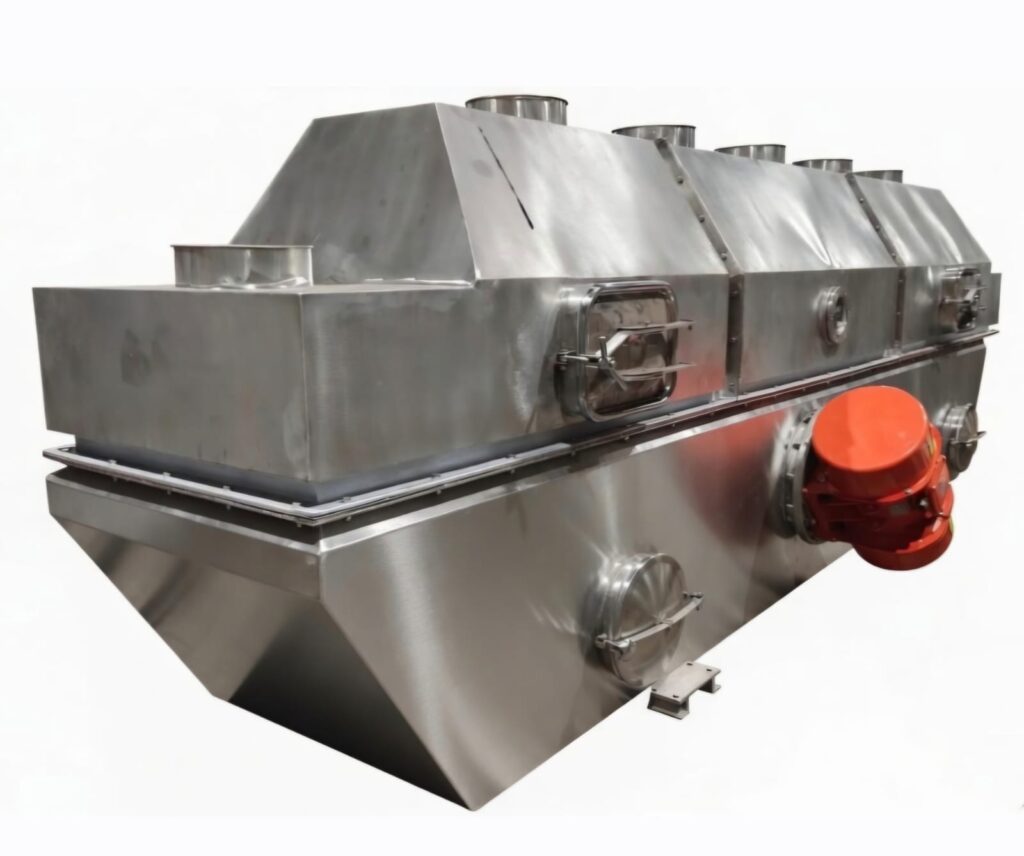
- Wet residue: PCA suggested a conveyor dryer like those used in desiccated coconut plants for large-scale work. GTI’s band dryer is one candidate. Residue is finer and more compressible than desiccated coconut, so bed depth, air distribution and belt mesh must suit it. A combination fluid bed dryer may suit some residues; trials should decide.
- Defatted cake re-drying to 2.5–3%: small evaporation load, but uniform final moisture matters for shelf life. A fluid bed stage such as GTI’s vibratory fluid bed dryer fits this duty.
Our sister site outlines fluid bed and band options for coconut flour drying systems and for related coconut meal drying.
Product quality and market notes
- Shelf life: PCA shelf-life testing reported 26 months at 20 °C, 14 months at 30 °C and 9 months at 40 °C for its residue flour. Storage temperature matters a great deal, so warehouse and export routing should be part of the plan.
- Dietary fibre: work by the Food and Nutrition Research Institute with PCA, cited in the same paper, found coconut flour’s total dietary fibre to be high and predominantly insoluble.
- Applications: PCA reported acceptable partial substitution for wheat flour in many baked, steamed and snack products, typically 5–25% and higher in a few items.
- Claims: labels such as “gluten-free” or “high fibre” depend on the target market’s rules and on test results for your product. Verify them before printing packaging.
- Feed supply: flour lines work best alongside a reliable residue source. PCA recommended pairing flour production with coconut milk processing.
GTI’s coconut milk processing plant and virgin coconut oil machinery both generate residue that can feed a flour line. Coconut flour is among the value-added products covered in GTI’s turnkey coconut projects overview.
Feasibility checklist
- How many tonnes of residue per day, at what moisture and oil content (dry basis)? Measure over several weeks.
- Is the residue pared (white) or does it include testa?
- How quickly can residue go from the press to the blancher and dryer?
- What expeller input moisture and temperature give acceptable colour? Plan a trial.
- What thermal and electrical utilities are needed for both drying stages?
- Flour specification: moisture, oil, particle size, colour and microbiology.
- Who buys the co-product oil, and to what specification?
- Packaging and warehouse temperature, given the shelf-life data.
Frequently asked questions
Can I dry residue and sell it without defatting?
You can, but residue at 35–46% oil (dry basis) is closer to a high-fat coconut powder than to flour. It will have a shorter shelf life, because more oil is exposed to oxidation, and it will not meet “flour” expectations. Defatting also recovers valuable oil.
Why does my dried residue turn yellow?
The PCA work found that residue held wet before drying, even in a freezer, turned yellowish. Over-high drying or expelling temperatures also darken the product. Shorten the delay and control temperatures first.
Is this an established commercial process?
The PCA paper describes pilot-scale optimisation and an economic assessment. It also notes that a suitable expeller of commercial size was still being developed at the time. Treat published yields and economics as a starting point to verify in trials, not as proven commercial performance.
Related guides and GTI equipment
This guide is part of GTI’s coconut processing series. Related reading and equipment:
- coconut milk extraction yield and fat balance: how much fat stays in the residue.
- what 1,000 nuts yield across product lines: where flour fits in the product mix.
- moisture testing for coconut products: checking flour moisture.
- GTI vibratory fluid bed dryer: dryer suited to residue.
- coconut flour drying systems: GTI flour dryer options.
Sources
- Bawalan, D.D., The economics of production, utilization and marketing of coconut flour from coconut milk residue, CORD (International Coconut Community).
- Codex Alimentarius, CXS 240-2003, aqueous coconut products, for coconut milk product definitions.
About this article
This article was prepared by the Genex Tech Industries LLP (GTI Group) editorial team from the published research listed above. The mass balance is illustrative and uses stated assumptions. Process conditions for a commercial line must be confirmed by trials on your residue.
Turn your residue into a product
Genex Tech Industries LLP (GTI Group), engineering since 1985, designs coconut processing and drying lines, including band, fluid bed and combination dryers. Share your residue volumes and analysis, and we can help plan trials and size the drying stages.
Request a quotation for a coconut flour line for your milk residue
Send your capacity, product specification and site details through our quotation request form, and GTI Group will respond with a proposal.
For more information, email mktg@coconutprojects.com or call or WhatsApp us on +91-87774 75596.