
Short answer: coconut water is about 95% water, so spray drying it directly means evaporating roughly 19 kg of water for every kilogram of coconut water solids. In the illustrative case below, pre-concentrating by reverse osmosis (RO) and then a multiple-effect evaporator cuts the spray dryer’s water load from about 950 kg/h to about 150 kg/h. The estimated total thermal demand falls from about 1,000 kW to roughly 225–280 kW. The trade-offs are capital cost, extra cleaning duty, flavour exposure to heat in the evaporator, and a stickier, more viscous dryer feed. Whether it pays depends on your capacity, fuel cost and quality target, so the decision should be made on a mass and energy balance, not a rule of thumb.
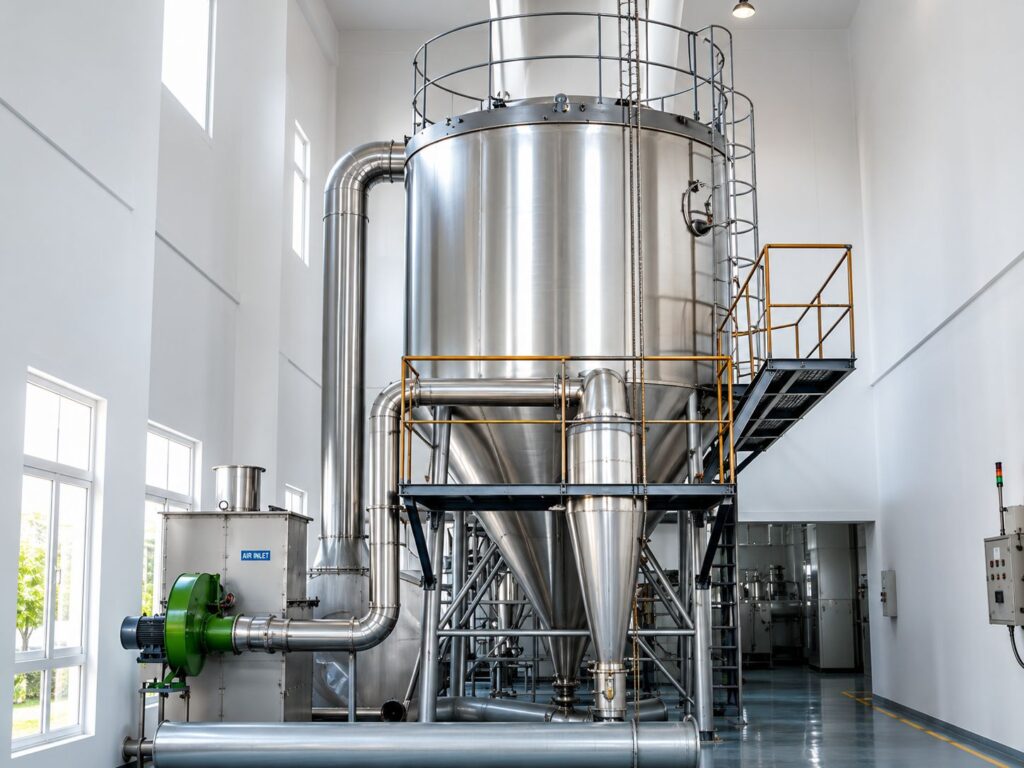
This article is for processors and project teams planning coconut water powder, or adding a powder line to a plant that already collects coconut water. It explains the options, works through the energy arithmetic with stated assumptions, and lists what to check before choosing a route.
Why concentration matters for coconut water
USDA FoodData Central lists coconut water at 95.0 g of water per 100 g, with about 3.7 g of carbohydrate; the rest of the solids are mainly minerals. Two consequences follow:
- Energy: almost all the mass entering a direct-feed spray dryer is water. Spray drying is an energy-intensive way to remove water compared with membranes or vacuum evaporation, as a 2017 paper in Drying Technology on spray-dryer mass and energy balances notes.
- Stickiness: the sugars make the powder sticky, so carriers such as maltodextrin are normally added. Our article on why coconut water powder sticks in the spray dryer covers glass transition, carrier ratio and outlet temperature. Concentration changes the feed but does not remove the need for that control.
Concentration also matters beyond drying. The authors of a 2023 membrane study note that the large volumes of coconut water that must be handled, stored and heat-treated are a cost barrier to exports, which is why concentrating it is attractive in its own right.
The concentration options
| Route | What the evidence shows | Main energy form | Quality considerations |
|---|---|---|---|
| Reverse osmosis (RO) | In a 2023 laboratory study (Journal of Chemical Technology & Biotechnology), RO at 25 bar reduced coconut water volume by up to half, raising Brix by about 90%, with negligible loss of ions and minerals | Electrical (high-pressure pumps) | Room-temperature operation; limited final concentration; membrane fouling and cleaning |
| Multiple-effect vacuum evaporation | Established in food and dairy processing; an EU energy-efficiency review (IMPEL, 2012) gives 1.1–1.2 kg of steam per kg of water for single-effect evaporators, 0.6–0.7 for double-effect and about 0.4 for triple-effect | Thermal (steam), plus electrical for pumps and vacuum | Heat exposure; loss of volatile aroma; fouling; reaches high concentration |
| Evaporation with vapour recompression (MVR or TVR) | The same review notes that mechanical or thermal vapour recompression reduces steam use further | MVR: mainly electrical (compressor); TVR: steam | As for evaporation; higher capital cost |
| Freeze concentration | A laboratory progressive freeze concentration study (International Journal of Food Science, 2020) took coconut water from 3.5 to 8.5 °Brix, with 73.6% yield, improved to 80% by partial ice melting | Electrical (refrigeration) | Best for heat-sensitive flavour; low concentration; not yet a common industrial route for coconut water |
Planning a coconut water powder line? Request a quotation from GTI.
Tell us your product, target capacity, raw-material data and site location. GTI Group engineers will review it and prepare a proposal for your project, in India or abroad.
Worked energy comparison
Illustrative example. The assumptions are chosen to show the method; they are not GTI performance figures or guarantees.
Basis: 1,000 kg/h of clarified coconut water at 5% total solids (50 kg/h of solids). Carrier added dry at 1:1 on coconut water solids, so it adds solids but no water. Powder at 3% moisture, wet basis, so 103.1 kg/h of powder containing 3.1 kg/h of water. No solids lost in RO permeate or evaporator condensate.
Spray dryer heat: estimated with the common approximation that thermal efficiency ≈ (inlet − outlet temperature) ÷ (inlet − ambient temperature). With 180 °C inlet, 85 °C outlet and 30 °C ambient (within the inlet and outlet ranges on GTI’s coconut water powder plant page), efficiency ≈ 95 ÷ 150 ≈ 0.63. Taking about 2,400 kJ to evaporate 1 kg of water gives about 3,800 kJ of heat per kg of water evaporated. This ignores wall and other losses. For comparison, the IMPEL review gives 2.5–3.5 MJ per kg of water as the practical range for drying liquids to solids, so 3.8 MJ/kg is a conservative planning figure.
Evaporator steam: 0.4–0.7 kg of steam per kg of water, covering triple- and double-effect evaporators on the IMPEL figures. We assume about 2,100 kJ of usable heat per kg of steam.
| Case | Spray dryer feed | Water evaporated in spray dryer | Spray dryer heat | Pre-concentration energy | Total thermal (approx.) |
|---|---|---|---|---|---|
| A. Direct spray drying | 1,000 kg/h at 5% TS | 947 kg/h | about 1,000 kW | none | about 1,000 kW |
| B. RO to 10% TS, then spray dryer | 500 kg/h at 10% TS | 447 kg/h | about 470 kW | RO pump power (electrical, supplier to state) | about 470 kW |
| C. RO to 10%, evaporator to 25% TS, then spray dryer | 200 kg/h at 25% TS | 147 kg/h | about 155 kW | 300 kg/h evaporated: 120–210 kg/h steam, about 70–123 kW | about 225–280 kW |
| D. Evaporator only, 5% to 25% TS, then spray dryer | 200 kg/h at 25% TS | 147 kg/h | about 155 kW | 800 kg/h evaporated: 320–560 kg/h steam, about 187–327 kW | about 340–480 kW |
How the numbers work for case C: 50 kg/h of solids at 25% gives 200 kg/h of concentrate. RO removes 500 kg/h of permeate and the evaporator removes a further 300 kg/h. The spray dryer then removes 150 − 3.1 ≈ 147 kg/h. With MVR, most of the evaporator’s steam is replaced by compressor power. That is an electrical load, not a thermal one, and its size for coconut water must be stated by the evaporator supplier. If you apply the IMPEL practical drying range (2.5–3.5 MJ/kg) instead of 3.8 MJ/kg, case A falls to about 660–920 kW, so the conclusion does not depend on the exact figure.
Two further points. The spray dryer in case C handles about one-sixth of the water of case A, so the chamber, air heater, fans and powder recovery can be much smaller for the same powder output. And the 25% concentrate figure is an assumption. The practical limit before spray drying depends on viscosity, atomisation and stickiness, and should be set by trials.
Keep thermal and electrical energy separate
| Equipment | Thermal energy | Electrical energy |
|---|---|---|
| RO | none (cleaning water heating only) | High-pressure and circulation pumps |
| Steam evaporator | Steam to first effect or thermocompressor | Pumps, vacuum pump, condenser water pumps |
| MVR evaporator | Small amount of steam for start-up and heat treatment | Compressor (dominant), pumps, vacuum |
| Spray dryer | Air heater (steam, gas or electric) | Supply and exhaust fans, atomiser, feed pump, conveying |
If the spray dryer’s air heater is electric, its “thermal” load becomes an electrical one, which changes the cost comparison completely. Ask every supplier to state both forms at the design point. For measuring them on an operating plant, see the gtidryers.com guide to running a dryer energy audit.
Quality and hygiene trade-offs
- Flavour: even under vacuum, evaporation exposes coconut water to heat and strips volatile aroma. RO and freeze concentration avoid most of that. If flavour is a selling point, run sensory trials on each route.
- Spoilage: coconut water deteriorates quickly once it leaves the nut. Every extra holding tank and membrane loop is another place for microbial growth. Chill early and design for cleaning. Our article on why coconut water turns pink or spoils explains the controls.
- Fouling and CIP: membranes and evaporator surfaces both foul and need validated cleaning, which costs water, chemicals and downtime.
- Powder behaviour: a more concentrated feed changes droplet size and drying. Atomiser choice matters; see rotary atomiser versus nozzles. After drying, hygroscopic powders can cake; see why dried powder cakes in bags and silos.
Where GTI equipment fits
GTI’s coconut water powder processing plant comprises collection and storage tanks, filtration and clarification, an optional evaporator or concentration unit, a mixing tank with dosing, a high-speed homogeniser, the spray dryer, cyclone or bag filter, an optional fluid bed dryer, sieving and packing. Upstream, the coconut water extraction machine supplies the raw water. Our sister sites cover the coconut water powder plant from a process viewpoint and coconut water powder drying systems. RO units are not listed on these product pages; if your balance favours RO, the membrane scope should be confirmed during engineering.
Decision checklist
- Powder output (kg/h) and carrier ratio, and therefore solids and water flows.
- Coconut water solids (°Brix) measured across seasons, not a single sample.
- Fuel and electricity tariffs, and whether the air heater will be steam, gas or electric.
- Flavour and colour targets, confirmed by trial powders from each route.
- Maximum feed concentration your atomiser and dryer can handle without sticking.
- Cleaning water, chemicals and effluent from RO and evaporator CIP.
FAQ
Is it always worth concentrating before spray drying?
No. At small capacities the capital and cleaning cost of concentration can outweigh the energy saved. Run the balance for your own output and tariffs.
Can coconut water be spray dried without a carrier if it is concentrated?
Concentration does not change the sugar composition that causes stickiness, so carrier and outlet-temperature control are still needed.
Related guides and GTI equipment
This guide is part of GTI’s coconut processing series. Related reading and equipment:
- why coconut water powder sticks in the spray dryer: stickiness and carrier ratio; this guide covers energy.
- coconut water pinking and spoilage: feed quality.
- coconut sugar from sap: another evaporation-led coconut product.
- GTI coconut water powder processing plant: turnkey line.
- coconut water powder drying systems: GTI dryers.
Sources
- USDA FoodData Central, SR Legacy food 170174, “Nuts, coconut water (liquid from coconuts)”: water 95.0 g and carbohydrate 3.71 g per 100 g.
- IMPEL (European Union Network for the Implementation and Enforcement of Environmental Law), Energy efficiency in permitting and inspection: food, drink and milk industries annex, 2012: evaporator steam use and drying energy ranges.
- Investigations on membrane performance for coconut water concentration under pressure and by osmotically driven process, Journal of Chemical Technology & Biotechnology, April 2023.
- Progressive freeze concentration of coconut water and use of partial ice melting method for yield improvement, International Journal of Food Science, 2020.
- Thermodynamic characterization of single-stage spray dryers: mass and energy balances for milk drying, Drying Technology, 2017.
About this article
Prepared by the Genex Tech Industries LLP (GTI Group) editorial team. The energy comparison is an illustrative calculation using stated assumptions and published general food-industry evaporator figures; coconut-water-specific performance must be established by trials and supplier data.
Plan your coconut water powder line with GTI
GTI Group, engineering since 1985, supplies coconut water powder plants and spray dryers. Share your coconut water volume, solids and target powder output, and we can work through the concentration and drying balance with you.
Request a quotation for a coconut water powder line
Send your capacity, product specification and site details through our quotation request form, and GTI Group will respond with a proposal.
For more information, email mktg@coconutprojects.com or call or WhatsApp us on +91-87774 75596.