
Short answer: most virgin coconut oil (VCO) that fails a buyer’s specification fails on three linked numbers: moisture, free fatty acids (FFA) and peroxide value. The widely used ICC (formerly APCC) standard sets maximums of 0.1% moisture, 0.2% FFA and 3 meq/kg peroxide value. Water left in the oil, together with enzymes and microbes carried over from the coconut milk, is what drives FFA up after packing. So the decisive controls sit in three places: how fresh the kernel and milk are, how cleanly the oil is separated, and how the last traces of water are removed at low temperature before filtration and filling.
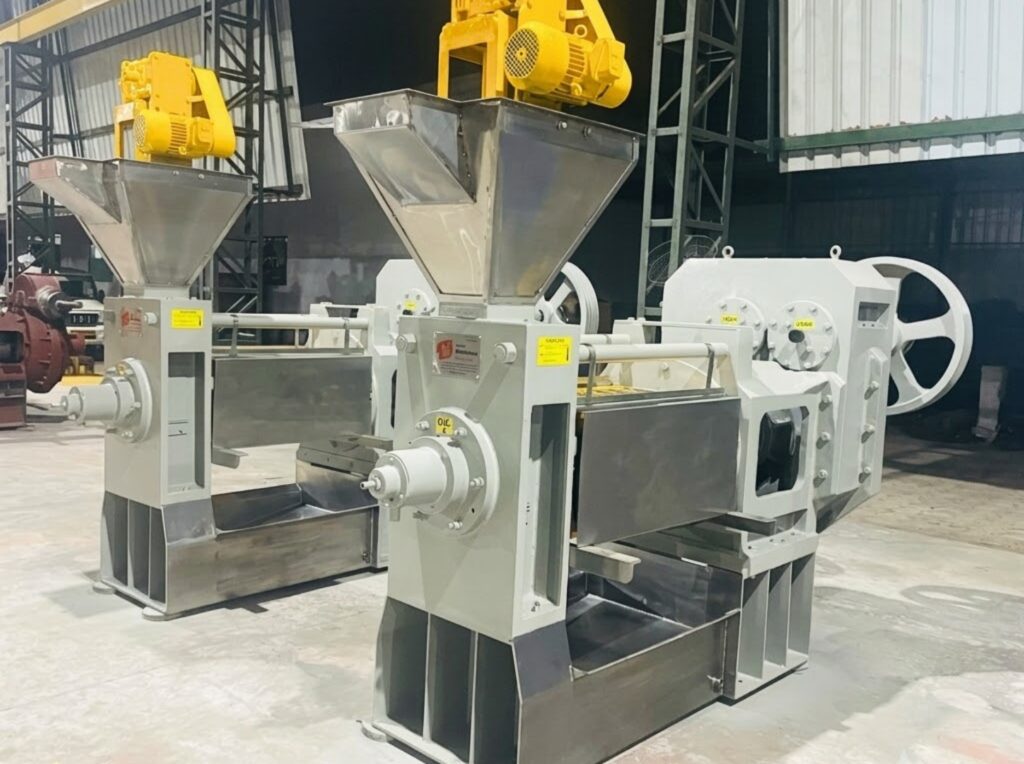
This guide is for VCO plant owners, quality managers and project teams. It compares the main standards, explains why moisture and FFA move together and works through the heat needed for final drying.
The specification numbers buyers actually check
There is no single global VCO standard yet. Buyers usually quote one of these documents, and the gaps are large.
| Parameter | ICC / APCC VCO standard | Philippine National Standard PNS/FDA 42:2022 | Codex CXS 210-1999, cold-pressed virgin oils (general) |
|---|---|---|---|
| Moisture, max | 0.1% | 0.10% (w/w) | No specific limit |
| Matter volatile at 120 °C | Max 0.2% | 0.12–0.20% | 0.2% at 105 °C |
| Free fatty acids | Max 0.2% | Max 0.20% (as lauric acid) | Expressed as acid value: 4.0 mg KOH/g |
| Peroxide value, max | 3 meq/kg | 3.0 meq/kg | Up to 15 meq active oxygen/kg |
Sources: ICC quality standard for virgin coconut oil; PNS/FDA 42:2022 and Codex CXS 210-1999 as compared in the Philippines’ proposal paper to the Codex Committee on Fats and Oils (CCFO29, 2026).
Convert units before you compare
FFA is often reported in different units, and this causes disputes. For coconut oil, FFA % as lauric acid ≈ acid value × 0.357, and FFA % as oleic acid ≈ acid value × 0.503. So:
- 0.2% FFA as lauric acid corresponds to an acid value of about 0.56 mg KOH/g, or about 0.28% FFA if a laboratory reports it as oleic acid.
- The Codex acid value of 4.0 mg KOH/g corresponds to about 1.4% FFA as lauric acid, roughly seven times the ICC limit.
Agree the unit, method and laboratory in the contract. A plant can pass Codex and still fail a buyer who wrote the ICC limit into the order.
Moisture: Karl Fischer versus volatile matter
Moisture by Karl Fischer titration measures water directly. “Matter volatile” is a weight loss on heating that also includes volatile aroma compounds. A study of commercial VCO samples by Dayrit and colleagues (CORD, 2007) found Karl Fischer moisture of 0.05–0.12% and volatile matter at 120 °C of 0.12–0.18%. They also found that heating at 105 °C did not always drive off all the water, which is why VCO standards use 120 °C. Specify which test applies to each limit.
A standards development to watch
At the 29th session of the Codex Committee on Fats and Oils (Kuala Lumpur, 9–13 February 2026), the Philippines proposed adding VCO to the Codex standard for named vegetable oils. The committee agreed not to start the new work yet. Members said the proposal had not shown clearly enough how VCO can be distinguished from ordinary coconut oil. The revised proposal may come back to a future session.
The practical message: authenticity testing will matter more over time. Plants that keep batch records of Karl Fischer moisture, volatile matter, FFA and peroxide value will be better placed whatever criteria are adopted.
Export context. In FAOSTAT trade data for 2024, the Philippines and Indonesia are by far the largest coconut oil exporters (about 1.67 Mt and 0.68 Mt, all coconut oil grades combined). For VCO exporters in these and other producing countries, buyers usually state limits against ICC, national (for example Philippine PNS) or Codex texts, so the comparison table above is the practical starting point. Source: FAOSTAT trade, accessed 21 November 2026.
Planning a virgin coconut oil line? Request a quotation from GTI.
Tell us your product, target capacity, raw-material data and site location. GTI Group engineers will review it and prepare a proposal for your project, in India or abroad.
Why moisture and FFA move together
FFA in VCO comes mainly from hydrolysis: water splits fatty acids off the triglyceride. The reaction needs water, and it is speeded up by lipase enzymes and by microbes. Both can be carried into the oil from the coconut meat and milk. Peroxide value measures something different: oxidation by oxygen, which is promoted by heat, light, metal contact and air in the headspace.
Coconut oil is highly saturated, so it resists oxidation better than most vegetable oils. In the CORD 2007 study, peroxide values in commercial VCO ranged from not detected to 1.4 meq/kg, well inside the 3 meq/kg limit, while FFA ranged from 0.042% to 0.329%, so some samples exceeded 0.2%. FFA and moisture are usually the harder numbers to control.
Where VCO quality is won or lost in the line
| Stage | What goes wrong | What to control and specify |
|---|---|---|
| Nut selection and storage | Cracked, germinated or over-stored nuts start fermenting before processing | Reject cracked and sprouted nuts; process on a first-in, first-out basis; record nut age at intake |
| Deshelling, paring and washing | Testa fragments, shell dust and dirty wash water carry microbes into the meat | Paring standard, potable wash water, regular changes of wash water |
| Grating and milk extraction | Grated meat and fresh milk spoil fast at tropical temperatures | Minimise holding time between grating, pressing and separation; chill milk if holding is unavoidable |
| Separation (centrifuge, fermentation or controlled heating) | Fine protein solids and water remain in the oil phase; long fermentations can raise FFA and give sour notes | Defined separation time and temperature; check oil clarity and moisture before the next step |
| Final moisture removal | High-temperature drying darkens colour and changes flavour; too little drying leaves water that fuels hydrolysis | Low-temperature drying under vacuum, with moisture checked by Karl Fischer at the outlet |
| Filtration and polishing | Haze and sediment carry enzymes and moisture into the drum | Specified filter grade; filter after drying, not before |
| Storage and filling | Humid air, light and metal contact during storage and filling | Stainless steel tanks, minimum headspace, closed transfer, light-protective packaging, dated batch records |
GTI’s published virgin coconut oil machinery line follows this sequence: dehusking, deshelling and paring, then grating, milk extraction, filtration and cream separation. Fermentation tanks are optional. Oil separation is followed by a vacuum or low-temperature dryer, oil filtration, SS storage tanks and filling. Choose the separation route (centrifugal, fermentation or controlled heating) on market and flavour grounds before equipment sizing.
Worked example: how much heat does final moisture removal need?
Illustrative example. The numbers show the method only. They are not measured results from any plant.
Assumptions: a 1,000 kg batch of separated VCO enters the dryer at 0.30% moisture (wet basis, Karl Fischer) and 30 °C. The target is 0.08% moisture, leaving a safety margin below the 0.1% limit. The oil is heated to 60 °C under vacuum. The specific heat of liquid coconut oil is taken as about 2.0 kJ/kg·K, a typical value for liquid vegetable oils. The latent heat of water at 50–60 °C is about 2,360–2,380 kJ/kg.
- Water in: 1,000 × 0.0030 = 3.0 kg water, so 997 kg of oil.
- Water allowed out: 997 × 0.0008 ÷ (1 − 0.0008) ≈ 0.80 kg.
- Water to evaporate: 3.0 − 0.8 ≈ 2.2 kg.
- Heat to evaporate it: 2.2 × 2,370 ≈ 5,200 kJ ≈ 1.4 kWh (thermal).
- Heat to warm the oil: 1,000 × 2.0 × (60 − 30) = 60,000 kJ ≈ 16.7 kWh (thermal).
In this example, warming the oil takes more than ten times as much heat as evaporating the water. That changes the engineering priorities:
- Heat recovery, for example cooling the dried oil against incoming oil, can matter more than the evaporation duty.
- The vacuum level matters because it sets the temperature at which water leaves. At about 10 kPa absolute, water boils at roughly 46 °C, so drying can run well below temperatures that would toast the flavour.
- Electrical load for the vacuum pump, agitator and transfer pumps is separate from the thermal duty above. Ask the supplier to state both separately.
If incoming moisture is much higher because separation is poor, fixing the separator is usually cheaper than oversizing the dryer.
Troubleshooting guide
| Symptom | Likely cause | First checks |
|---|---|---|
| FFA within limit at dispatch but above limit at the customer | Residual moisture or fine solids allowing slow hydrolysis | Karl Fischer moisture at the dryer outlet; filter performance; drum headspace and storage temperature |
| FFA high straight off the line | Old or damaged nuts, long holding of grated meat or milk, over-long fermentation | Intake records, holding times, fermentation time and temperature |
| Peroxide value rising | Air, light or heat exposure; contact with non-stainless metals | Tank materials, headspace, packaging light barrier, drying temperature |
| Yellowish colour or roasted note | Excessive heat during separation or drying | Temperature logs; vacuum level; residence time |
Buyer checklist for a VCO line quotation
- Which standard does the line design target: ICC, a national standard or a customer specification? Are FFA units stated?
- What separation route is quoted, and what is the guaranteed oil moisture at the separator outlet?
- For the dryer: batch or continuous, working vacuum, maximum oil temperature, and outlet moisture by Karl Fischer.
- Thermal duty and electrical load stated separately.
- Filter type and grade, and whether filtration follows drying.
- Contact materials for oil-wetted parts, the cleaning procedure, and the in-house tests needed (Karl Fischer, FFA, peroxide value).
- How the residue left after milk extraction will be used. Our guide to turning coconut milk residue into coconut flour covers one option.
Related processes
Converting VCO into powder needs an emulsion and a spray dryer: see GTI’s VCO powder processing plant and our sister site’s VCO powder drying systems. Dry-process oil, pressed from dried kernel, uses industrial oil expellers instead of milk separation. For MCT fractions, see the MCT oil processing plant.
Frequently asked questions
Is 0.1% moisture really necessary if the oil looks clear?
Yes. Water at these levels is invisible, yet enough to support hydrolysis over months of storage. Only a measurement such as Karl Fischer titration tells you the real figure.
Can I fix high FFA by drying harder?
No. Drying stops further hydrolysis, but it does not reverse FFA that has already formed. Removing FFA needs refining, after which the oil would no longer be sold as virgin. Prevention upstream is the only route.
Does vacuum drying change VCO flavour?
Low-temperature vacuum drying is used precisely to limit heat damage. Some light aroma volatiles may still be lost. The exact effect on your product should be confirmed in a material trial.
Related guides and GTI equipment
This guide is part of GTI’s coconut processing series. Related reading and equipment:
- MCT oil from coconut oil: yield and routes: a downstream use of refined coconut oil.
- copra drying, aflatoxin and PAH control: the copra route to coconut oil.
- mature coconut water from a VCO plant: what to do with the water stream.
- GTI virgin coconut oil machinery: VCO line equipment.
- GTI VCO powder processing plant: turning VCO into powder.
Sources
- International Coconut Community, Quality standard for virgin coconut oil.
- Coconut Development Board (India), Coconut products: composition of VCO as per APCC.
- Dayrit, F.M. et al. (2007), Essential quality parameters of commercial virgin coconut oil, CORD 23(1).
- Codex Committee on Fats and Oils, 29th session (February 2026): VCO new-work proposal (CRD19) and draft meeting report.
About this article
This article was prepared by the Genex Tech Industries LLP (GTI Group) editorial team from the published sources listed above. The worked example is illustrative and uses stated assumptions. It is general technical guidance, not a laboratory method or certification advice. Plant-specific drying conditions should be confirmed by material trials.
Plan your VCO line with GTI
Genex Tech Industries LLP (GTI Group), engineering since 1985, designs complete coconut processing lines, including VCO extraction, separation, low-temperature drying, filtration and packing. Share your target specification and capacity, and we can review the process route with you.
Request a quotation for a virgin coconut oil line
Send your capacity, product specification and site details through our quotation request form, and GTI Group will respond with a proposal.
For more information, email mktg@coconutprojects.com or call or WhatsApp us on +91-87774 75596.