
Short answer: crisp, light-coloured coconut chips come from five controlled steps. Start with nuts of the right age (about 8–10 months). Blanch the pared kernel. Slice it thin and evenly. Give the slices a short sugar-syrup (osmotic) dip. Then dry gently to below about 4% moisture and a water activity under 0.5, and toast at the end only if you want a toasted flavour. After that, packaging decides shelf life. Published work shows that rancidity (peroxide value), not texture or colour, is usually the first thing to fail, so barrier pouches and low-oxygen packing matter as much as the dryer.
This guide is for snack manufacturers, coconut processors adding a retail product, and entrepreneurs scaling up from batch ovens. It covers the process window, a worked water-removal example, dryer choices and the faults that most often spoil a batch.
The process at a glance
The Coconut Development Board (CDB), India, publishes a project profile for coconut chips. Its flow is dehusking, deshelling, paring, blanching, draining, slicing, osmotic soaking, drying, cooling and packing. The table adds the purpose and the main control point for each step.
| Step | CDB profile guidance | Why it matters / what to control |
|---|---|---|
| Nut selection | Nuts 8–10 months old with reasonable water inside | Kernel thick enough to slice, but still tender. Fully mature kernel gives harder, oilier chips |
| Deshelling and paring | Remove the shell without breaking the kernel; remove only the brown testa | Testa left on gives dark specks. Over-paring wastes kernel |
| Blanching | Pared kernels in boiling water with 0.05% potassium metabisulphite for 15 minutes | Inactivates enzymes, reduces microbial load and helps colour. Sulphite use must meet the additive and labelling rules of your target market |
| Draining | Vibratory screener | Surface water dilutes the syrup and adds drying load |
| Slicing | Thin slices with a slicer or peeler | Thickness uniformity is the biggest single factor in even drying |
| Osmotic dip | Sugar syrup at 50 °Brix for 1 hour, with a little salt and optional flavour; agitate | Draws out water, adds sweetness and helps crispness. Syrup strength and time set sugar uptake |
| Drying | 70–80 °C for 4–5 hours in a hot-air dryer; turn after the first hour | Remove water without browning or case-hardening |
| Toasting (optional) | Raise to about 90 °C until golden brown | Flavour and colour development. Stop before scorching |
| Cooling and packing | Metallised or aluminium-foil laminate pouches; nitrogen flushing reduces breakage | The chips are hygroscopic. Pack cool and fast |
Other published schedules differ. A Thai shelf-life study in Processes (2022) used 8–9-month kernel, a sucrose pre-treatment and drying at 60 °C for 20 hours. So treat temperatures and times as starting points for your own trials, not fixed recipes.
Moisture and water activity targets
In the Processes study, fresh kernel pieces started at 67.95% moisture (wet basis). The dried chips stayed at or below 4% moisture and a water activity of 0.5 or less throughout storage. That makes a sensible release specification. The study’s crispness data also show texture declining as chips age in storage, so keeping moisture pick-up low protects crispness.
The same study tracked colour, crispness and peroxide value in aluminium-foil pouches at 35, 45 and 55 °C. Peroxide value was the limiting factor. It predicted shelf lives of 144, 128 and 115 days at those temperatures, about 159 days at ambient and 194 days refrigerated. The CDB profile cites up to six months in metallised or foil laminate pouches. Both point the same way. For coconut chips, oxygen and light protection usually matter more than chasing the last 0.5% of moisture.
Planning a coconut chips line? Request a quotation from GTI.
Tell us your product, target capacity, raw-material data and site location. GTI Group engineers will review it and prepare a proposal for your project, in India or abroad.
Worked example: how much water does the dryer remove?
Illustrative case. Output: 100 kg/h of finished chips at 3% moisture (wet basis). Inlet moisture after the syrup dip and draining: 50–60% (wet basis). The inlet figure is an assumption. Fresh kernel is around 68%, and the dip removes some water while adding sugar. Measure yours.
- Dry solids in the output: 100 × 0.97 = 97 kg/h.
- Wet feed at 50% moisture: 97 ÷ 0.50 = 194 kg/h, so evaporation is about 94 kg/h.
- Wet feed at 60% moisture: 97 ÷ 0.40 ≈ 243 kg/h, so evaporation is about 143 kg/h.
Keep the three numbers separate when you talk to dryer suppliers: wet-feed capacity (194–243 kg/h), finished output (100 kg/h) and evaporation (94–143 kg/h). A 10-point change in inlet moisture moves evaporation by about 50%. Heating can be steam, thermic fluid, gas or electric. Ask for thermal demand (kW or kg/h of steam) and electrical load (fans, belt drives, controls) as separate figures.
For raw material, the CDB profile states that 420 kg of coconuts (1,000 nuts) give about 100 kg of chips. So 100 kg/h of chips needs roughly 1,000 nuts an hour. Husk, shell and coconut water are by-products. Our article on what to do with mature coconut water covers the water stream.
Batch oven or continuous band dryer?
| Factor | Batch tray dryer / hot-air oven | Continuous multi-zone band (belt) dryer |
|---|---|---|
| Typical fit | Start-ups and small batches; the CDB profile is built around a hot-air oven for 100 kg of chips per shift | Steady daily volumes and export programmes |
| Uniformity | Depends on tray position and manual turning | Each slice sees the same time–temperature profile |
| Drying then toasting | Change the set-point mid-batch | Separate zones for drying, toasting and cooling |
| Sticky syrup-coated slices | Turned by hand | Needs a suitable belt, an even spreading system and, if required, transfer between belts to turn the product. Confirm in trials |
| Labour and hygiene | Heavy handling | Less handling; plan for belt-cleaning access |
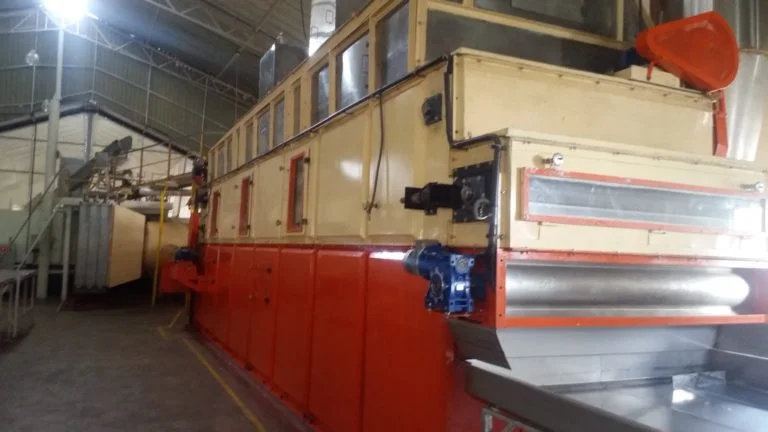
GTI’s band dryer for coconut processing is designed for continuous, multi-zone drying of coconut kernel. For chips specifically, GTI Dryers explains its coconut chips drying systems. The detailed dryer comparison is in its guide to band and combination fluid bed dryers for chips, flakes and threads. Upstream, our desiccated coconut machinery line covers deshelling, paring and steam blanching, which are the same front-end steps. Slice thickness is discussed in the group’s article on choosing a chips cutter or food slicer.
Troubleshooting common faults
| Fault | Likely causes | What to check |
|---|---|---|
| Chips too dark or uneven brown | Air too hot for the sugar level; uneven slice thickness; testa specks | Zone temperatures, syrup °Brix, slicer setting, paring quality |
| Soft or leathery chips | Final moisture above about 4%, or moisture picked up after drying | Exit moisture and water activity; cooling time; pouch seal and barrier |
| Rancid taste within weeks | Oxygen and light exposure; warm storage; over-toasting | Pouch structure, residual oxygen, storage temperature, peroxide value at release |
| Slices stuck together or to trays | Excess surface syrup; overloaded beds; no early turning | Draining step, bed loading, first-hour turning or belt transfer |
| High breakage in pouches | Very thin slices; over-drying; drop heights in packing | Thickness, final moisture, filling heights, nitrogen cushioning |
Buyer checklist before requesting a quotation
- Finished output (kg/h) and operating hours.
- Measured inlet moisture after the dip, and target final moisture and water activity.
- Slice size and thickness, and whether a toasted variant is planned.
- Syrup recipe range: °Brix, salt and flavours.
- Available heating source and power.
- Retail packaging format and target shelf life.
- Food safety and export certification needs.
FAQ
Can fully mature (12-month) nuts be used?
Yes, but chips from fully mature kernel tend to be harder and oilier. Published profiles specify 8–10 months for the classic crisp, sweet chip.
Is the osmotic dip essential?
It is how most published processes achieve a sweet, crisp, non-fried chip. Unsweetened chips are possible, but the drying and texture behaviour changes, so trial them separately.
Are these drying conditions GTI specifications?
No. They are from the CDB profile and published research. Final conditions should be set through product trials on the selected dryer.
Related guides and GTI equipment
This guide is part of GTI’s coconut processing series. Related reading and equipment:
- DC grades and sieving: the cutting and grading side.
- packaging to protect shelf life: packing chips against moisture pickup.
- moisture and water-activity testing: checking crispness targets.
- GTI combination fluid bed dryer: GTI lists coconut chips among its applications.
- coconut chips drying on gtidryers.com: GTI chips dryers.
Sources
- Coconut Development Board, India, Coconut Chips: project profile.
- N. Choosuk et al., Kinetic modeling of quality changes and shelf life prediction of dried coconut chips, Processes 10(7):1392, July 2022.
- K. Ponnusamy et al. (ICAR-CPCRI), “Coconut chips – a crispy innovation in value addition”, Indian Farming, October 2026.
About this article
Prepared by the Genex Tech Industries LLP (GTI Group) editorial team from the published sources listed. The water-removal example is illustrative and uses a stated inlet-moisture assumption. Product and dryer settings must be confirmed by trials.
Scale up your coconut chips line with GTI
GTI Group, engineering since 1985, supplies coconut front-end machinery, band dryers and complete coconut processing lines. Share your target output, slice format and packaging plan, and we can help you size the line.
Request a quotation for a coconut chips line
Send your capacity, product specification and site details through our quotation request form, and GTI Group will respond with a proposal.
For more information, email mktg@coconutprojects.com or call or WhatsApp us on +91-87774 75596.